
🧭 Inner Compass: Honor Over Approval
Are we raising polite children or self-abandoning ones?


This is a letter to myself as much as it is to you.
The realization of honor came, as it often does, through my children. My awareness of them is so heightened that clarity floods in as a byproduct. When I watch them closely enough, I begin to see myself.
It was a regular Tuesday morning in the pediatrician waiting room. My son and I were sitting, waiting to be called. In the corner was a play area where he gravitated toward a wooden color block puzzle and an interactive table. He was fully absorbed, turning hexagons and spheres in his hands, studying how they fit together.
Then his name was called.
“Room two.”
Instinctively, I reached to take the puzzle from him just as he was beginning to understand it. He pulled back, clearly not ready to let it go.
And I paused.
What unspoken social rule demands that I interrupt his focus in the name of politeness? Is it even polite to silence curiosity because someone says THEY’RE ready for YOU to move? Who am I honoring when I override his concentration for the comfort of a stranger? Is it honorable to silence focus? Or is real honor found in protecting what is authentic and present?
So I decided to not pull the toy away from him.
To my surprise, the doctor smiled and encouraged us to bring the toy inside. Then my thoughts solidified. There was no rule I had broken. No invisible law I had offended. The pressure had lived entirely in my own head.
We carried the wooden puzzle down the hallway into room two. No drama. No tears. Just a small boy still figuring out how shapes move.
It felt like a quiet rite of passage. A reminder that not every moment needs tightening. Not every transition requires shrinking.
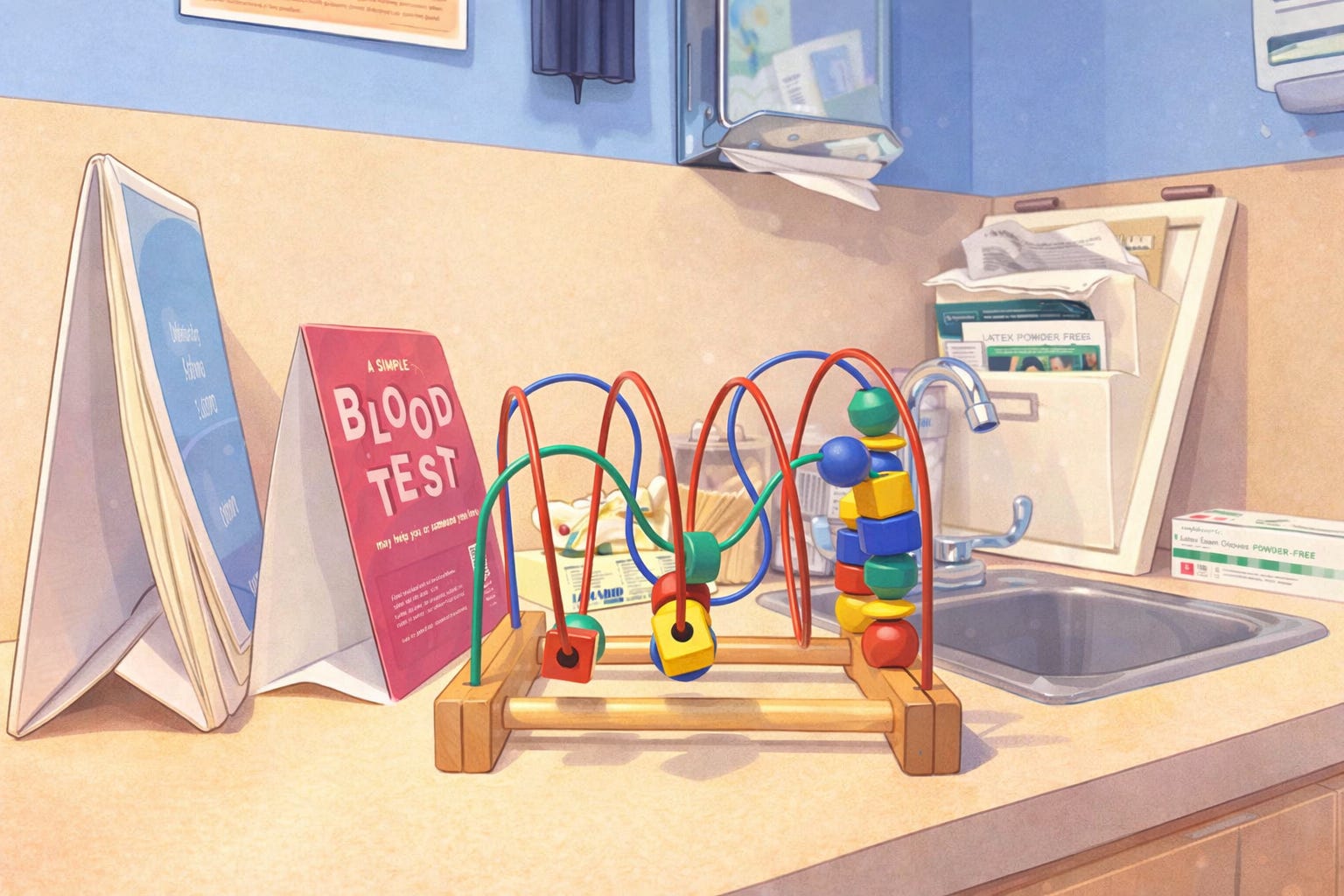
What a relief it was not to manage a crying toddler at 10:30 in the morning. But more than that, what a relief it was to realize that he did not need to contract himself to move from one room to another.
Who knows what he needed in those twenty minutes of figuring out how discs and spheres relate to one another. I am glad he took up space. I am glad he stayed immersed in something that mattered to him. I am glad he did not adjust himself to fit a rule that did not exist.
Such a small moment. Yet it moved something deeper in me.
Somewhere along the way, I confused shrinking with honor. I thought being agreeable meant being good. I thought approval was proof that I had behaved correctly. But honor is not self erasure.
Honor is defined as an individual's sense of self‐worth and their reputation within the community. Interestingly, it is the person’s judgment of themselves that influences the reality. No one else is appointed to do that but us. Practicing honor allows us to stand true without apology.
I have spent too much time feeling small. Dimming my voice to be polite. Giving space to others while squeezing myself into the margins of my own page.
To that, I now say:
Take up space.
It belongs to us just as much as it belongs to anyone else. Our workplace. Our home. The rooms we enter. The conversation we join.
Choose honor over approval.
Express yourself thoughtfully, not to be seen, but simply to be. Take the space you need to feel steady. No tightening in your chest. No quiet performance. No disappearing in plain sight.
Just be.
I hope my sons move through rooms without shrinking first. I hope they learn that respect does not require self abandonment.
And I will keep practicing to honor myself and my family. Just as I want them to learn.
🌿 The rationale of honor coming from within
1. Honor is internal, not just social
Honor lives at the intersection of how you see yourself and how others experience you. Beyond appearance, your inner self only shines when you let it be seen and understood. In that way, you hold some ownership over how your spirit is perceived within your social world.
That means your own thoughts and self-judgment are a real part of honor, not just reputation.
2. Honor works like a mental framework
Researchers describe honor as a kind of “cognitive structure,” meaning:
it shapes how you interpret situations
it guides your reactions
In simple terms: your brain uses honor as a lens to make sense of the world.
3. Emotions tied to honor are self-generated
Feelings like pride, shame, and anger come from how you interpret a situation.
Two people can experience the same event but feel different levels of “honor threat” depending on their mindset.
4. Honor can affect health decisions through beliefs
People who strongly value honor may:
avoid asking for help because they feel it makes them look weak
take more risks to feel strong or respected
These choices come from internal beliefs, not just outside pressure.
5. Honor can exist even without an audience
Honor lives in the quiet place between what you believe and how you act when no one is watching. Even in private moments, people often shape their behavior through an imagined sense of how they would be understood. In that way, honor becomes less about performance and more about staying true to your values, whether or not anyone else ever sees it.
🎯 Family Q&A: Try asking these questions to your children
When do you feel most like yourself, even if no one else notices?
Have you ever wanted to keep doing something because it felt important to you? What was it?
What is the difference between being kind and being quiet?
Have you ever said yes when you really wanted to say no? What did that feel like inside?
What makes you feel strong and steady on the inside?
If your inner voice could talk, what would it say when something does not feel right?
What is something you would stand up for, even if you were the only one?
💛 What We Carry Forward:
Honor lives in the quiet moments, when you choose not to rush what is unfolding, and let truth breathe without interruption.
So many of the rules we follow were never spoken aloud, yet we shrink as if they were written in stone.
Each small choice reveals devotion, to approval, or to self, to comfort, or to something deeper and steady.
Taking up space is not loud or forceful, it is the soft decision to remain whole where you once would have folded.
Honor is not just what others think about you. It is also built from your own thoughts, beliefs, and interpretations. Your mind plays a major role in creating and protecting your sense of honor.
The journey continues! Check your inbox tomorrow for “Crafty Workshop.” It is filled with simple activities to bring the honor theme into your family playtime. Feel free to share your experiences or suggest topics you’d like to see more of.
Link to my latest article here!
🧭 Inner Compass: 5 Ways to Practice Gratitude Together as a Family

I know it’s not November, but hear me out. Gratitude is much more than a holiday tradition. It is a quiet, steady mindset that keeps us grounded when life feels overwhelming.
Psychological review on honor shared here!
https://pmc.ncbi.nlm.nih.gov/articles/PMC10078545/
“Express yourself thoughtfully, not to be seen, but simply to be. Take the space you need to feel steady. No tightening in your chest. No quiet performance. No disappearing in plain sight.” This part of the article encourages parents to take things slow. I appreciate this take.
Such a strong piece of writing. I love this idea of the Inner Compass and the intrinsic value of finding honor.